5 terms observed in the article for this week (3): [Y.Zhao et. al High-Throughput Discovery of Novel Cubic Crystal Materials Using Deep Generative Neural Networks. Advanced Science, no. 8, p. 2100566, 2021. https://doi.org/10.1002/advs.202100566. Specific terms
As discussed in Reading Diary #2, preservation of crystalline symmetry of generated samples is a known problem. This problem can be partially solved by restrictions on generated symmetries. In this article, the authors propose CubicGAN, a generative adversarial network (GAN) based deep neural network model for the large-scale generative design of novel cubic materials.
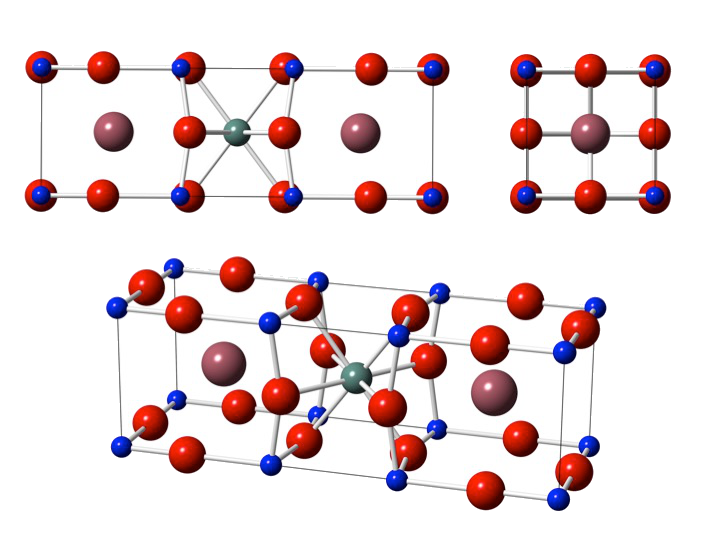
Crystal Prototype
Crystallographic prototypes provides a complete description of each known structure, including formulas for the primitive vectors, basis vectors, and description of the standardized cells in common digital fileformat. [http://aflowlib.org/prototype-encyclopedia/]
Example: The prototype “ABC2-225” was taken as an example. Here ABC2 and 225 were the crystal prototype anonymous formula and the space group number used to denote a prototype, and this format was used in the following content.
en: Прототип кристаллической структуры
Data-driven accelerated design
In this context, the term "data-driven design" lies at the intersection of the fields of programming and materials science.
From a programming perspective, a data-driven approach is a way of designing intelligently that focuses on data first, not how it is related.
In terms of materials science, the data-driven approach is a materials development paradigm based on the application of strong statistical analysis to select an experimental route.
"Accelerated" in this context means that some of the less efficient brute-force methods can be replaced by statistical and computational approaches.
Three main approaches to intelligent design can be distinguished:
data driven design,
Domain Driven Design,
Event Driven Design.
Example: Data-driven accelerated design of new materials is emerging as one of the most promising approaches for addressing the challenges in finding next-generation materials. Currently, one of the main strategies for materials discovery is screening existing materials databases.
en: Ускоренный дизайн, основанный на анализе данных
Framework
noun
In computer programming, a software framework is an abstraction in which software, providing generic functionality, can be selectively changed by additional user-written code, thus providing application-specific software. It provides a standard way to build and deploy applications and is a universal, reusable software environment that provides particular functionality as part of a larger software platform to facilitate the development of software applications, products, and solutions. Software frameworks may include support programs, compilers, code libraries, toolsets, and application programming interfaces (APIs) that bring together all the different components to enable the development of a project or system. [https://en.wikipedia.org/wiki/Software_framework](accessed Mar 1, 2022
Example: The framework primarily contained two steps: GAN training and material generation.
en: имплементированная программная инфраструктура
High-throughput screening
Phrase (adjective + noun)
In this context, High-throughput screening is the method for fast and robust searching of crystalline structures in certain systems of chemical elements, which can replace the resource-consuming first-principles calculations.
Generally, High-throughput screening (HTS) is a method for scientific experimentation especially used in drug discovery and relevant to the fields of biology, materials science, and chemistry. Using robotics, data processing/control software, liquid handling devices, and sensitive detectors, high-throughput screening allows a researcher to quickly conduct millions of chemical, genetic, or pharmacological tests. Through this process, one can quickly recognize active compounds, antibodies, or genes that modulate a particular biomolecular pathway. The results of these experiments provide starting points for drug design and for understanding the noninteraction or role of a particular location. [https://en.wikipedia.org/wiki/High-throughput_screening](Accessed Mar 1, 2022)
Example: High-throughput screening has become one of the major strategies for the discovery of novel functional materials.
en: Высокопроизводительный скрининг
Large scale generation [of data]
Large-scale data generation must be distinguished from big data generation.
Large-scale generation is a way to justify the operability of a software system based on a generative model. In this case, the conditional data generation should cover as much of the study space as possible.
In the case of materials science, study space is the structural phase space of various systems of chemical elements.
Example: Large scale generation of new materials with distinct structures and functions are highly desirable for widely used high-throughput screening based materials discovery.